
A snapshot of recipe-based marketing of commercial baby and toddler products and toddler formula: An unnecessary cost.
Consumption of healthy foods over the first 3 years of a child’s life is foundational for growth and development, creating a healthy microbiome and building taste preferences and acceptance of a range of food textures.
The rise of commercial ultra processed foods targeted to babies and toddlers and unnecessary toddler formula (also called toddler milk or follow on formula) has concerned the nutrition community for some time. These foods are usually soft or dissolvable, have a consistent taste and limited flavour options and are usually sweet. They are also extraordinarily expensive. Toddler formulas also have a sweet familiar taste and are filling, which, if offered regularly, can reduce a child’s interest in exploring new foods.
Originally, commercial baby and toddler foods and toddler milks were positioned in marketing as an aid for fussy eating or as a convenient option on the run (less mess).
I and others have been concerned by recent marketing which promotes these foods as components to add to recipes. This newer message positions these foods and milks as something to give toddlers even more frequently normalising them in a child’s diet. If these foods and formulas are mixed into meal and snack recipes there are less opportunities for toddlers to experience the taste of family foods or experience other textures.
To understand how commercial toddler foods formulas are being promoted in recipes I have explored the promotion of commercial baby and toddler foods and toddler formulas through recipe-based ads by collecting digital and magazine ads over one month (October 2025) where a recipe was used to promote a toddler food or formula. Results were analysed by food groups and for cost. I also explored the cost of alternative recipes substituting out the commercial toddler food or formula.
I found 5 recipe-base ads promoting a toddler milk. They all contained at least 3 core food groups from the Australian Dietary Guidelines (one recipe had all 5) indicating they are nutritious recipes without the need for a supplementary milk formula. The recipes cost $2.85-$5.53 per batch (average $3.68). But when I subbed out the toddler formula for milk or milk powder the recipes were 14-24% cheaper.
Due to the increase in the price of dairy and other ingredients I wanted to cross-check it would be a true saving if toddler formula was substituted for full cream milk or full cream milk powder across all situations and therefore compared the cost of these commercial toddler foods at the same major supermarket per 8g protein and 640kJ (which is the equivalent of 1 cup of milk).

The cost of 8g protein or 640kJ from toddler milk vs full cream milk powder vs fresh milk
As has traditionally been the case, it remains that on per serve of protein or energy (equivalent to a cup of milk) full cream milk powder followed by full cream milk remains significantly cheaper than a serve of toddler milk (around half the cost, depending on brand).
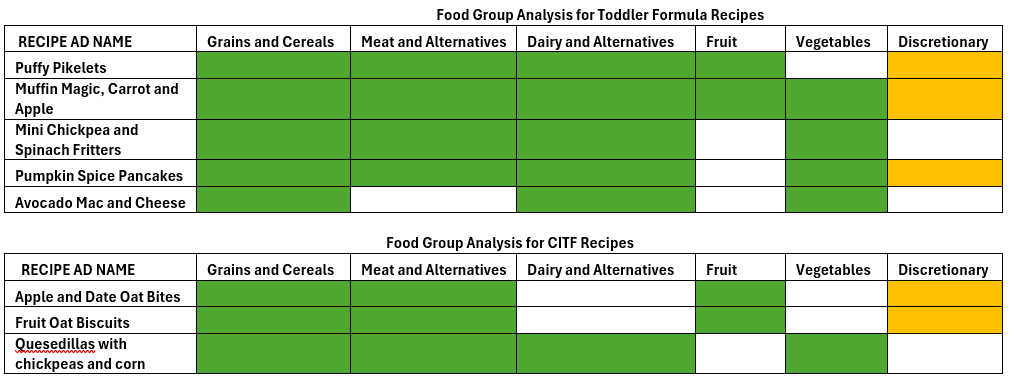
A summary of how each recipe featured in an ad is make of ingredients from core and or discretionary food groups.
For the 3 identified recipe-based ads promoting commercial infant and toddler foods (CITF) the cost differences were even more stark.
The three recipes cost $6.73, $12.55 and $15.42 per batch and when substituted for pantry staple ingredients or fresh fruit and vegetables the cost reduced by 14-44% at $5.78, $7.09 and $11.82. These recipes containing a commercial infant or toddler food again contained 3-5 core food groups indicating they would be a nutritious option without the addition of a commercial toddler food.
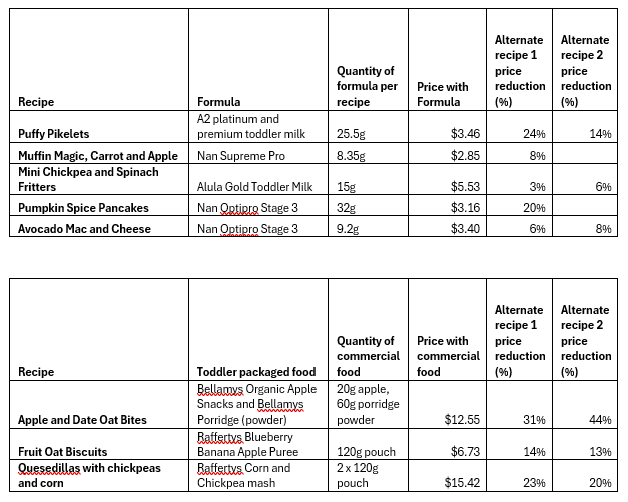
Cost of each recipe vs healthy alternative recipes omitting the commercial toddler formula or food.
These results support previous findings that conclude the current food regulatory system is letting parents down. Most children don’t need dietary supplements including toddler milks. The promotion of toddler specific snacks and meals undermines parents’ efforts to provide a range of family foods to their child. Future regulatory improvements would include nutrition composition limits and labelling rules for toddler foods paired with limits on claims that can be made. Toddler milks are an unnecessary product that dietitians do not recommend for children. Food regulation must acknowledge this fact when reviewing rules around toddler milks including compositional limits and how they can be labelled and marketed.
In the meantime dietitians can add their voices advocacy efforts for more appropriate regulations on toddler foods and drinks that support parents’ efforts to provide healthy foods to their children. Dietitians should also continue reassure parents they can provide a nutritious range of foods to their children without the need for toddler specific foods and formulas and will likely save on their food bill too.