
Marketing of unhealthy products in outdoor places. Looking for the policy gaps: What are the solutions?
Policies to protect the community from outdoor unhealthy advertising range from effective, to complex, to (frankly) useless. I have worked on policy solutions for outdoor unhealthy marketing over the past 10 years, looking at unhealthy food and drink, alcohol and to a lesser extend gambling. I have noticed that polices are ad hoc, perhaps reflecting varying levels of interest in reform at different times. I share here my insights into how current policies came to be, and which ones have led to reduced unhealthy advertising, highlighting the most effective types of policy. Finally, I also provide future solutions.
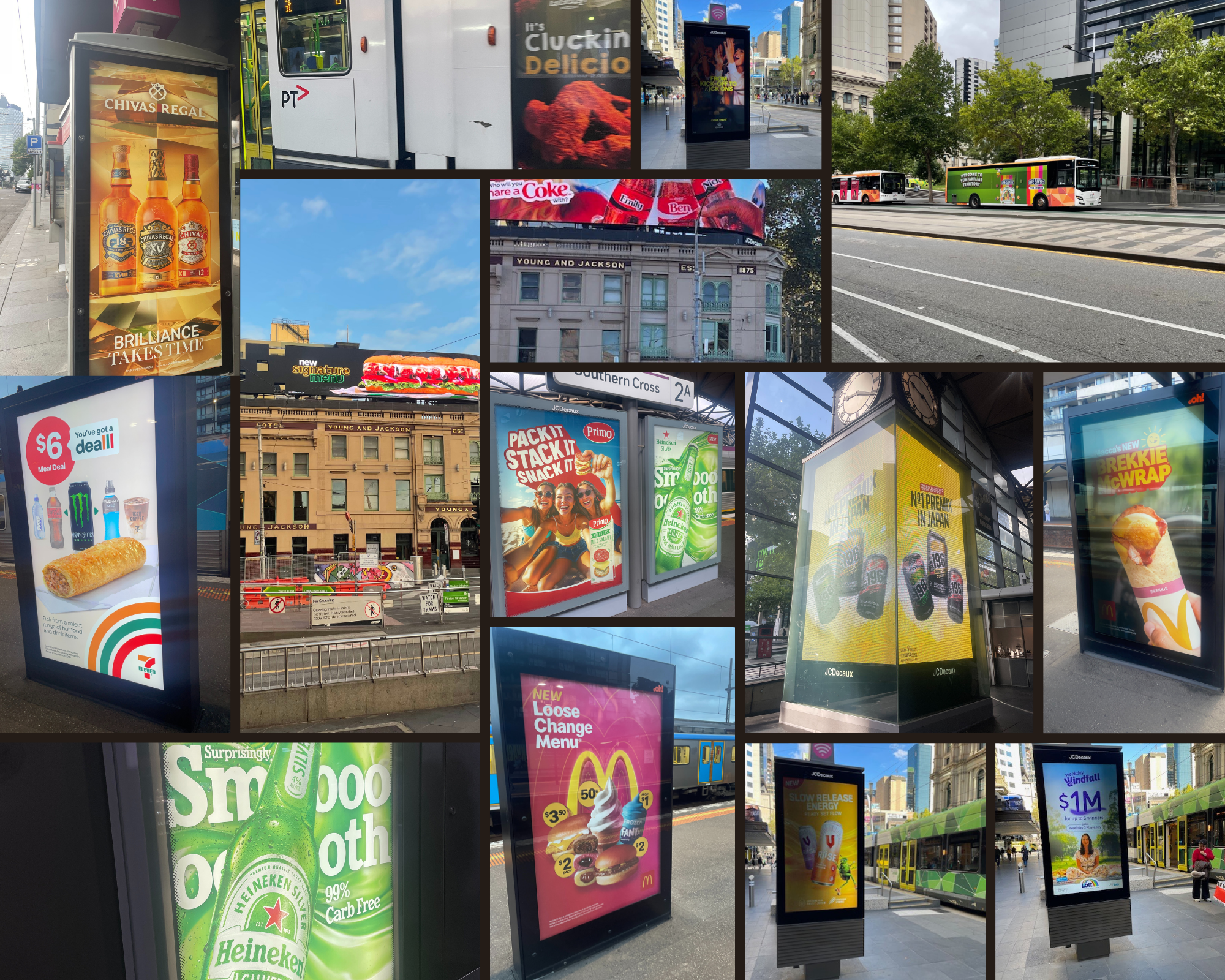
Collage of unhealthy marketing images from Melbourne, Victoria
If you drive down any arterial road or catch a train into an Australian city it’s easy to see the amount of unhealthy advertising that occurs in outdoor settings. Some Australian studies have found that over 70% of food and drink ads on public transport are for unhealthy products[i] [ii] [iii]. The recent addition of video advertising has made it more difficult to ignore. The public health community has, for decades, been calling for outdoor unhealthy marketing to be stopped, arguing that public assets should not be used as real estate for marketing harmful products such as alcohol, gambling and unhealthy food and drinks. It is particularly important to protect children from unhealthy advertising as they travel to school and through the community. Reducing exposure to unhealthy marketing, is one policy component required, amongst others, to improve the food environment and ultimately children’s diets. Removing harmful product marketing will also protect people struggling with gambling or alcohol addiction and those trying to cut back.
I have observed in my work that there are many different rules across three unhealthy product types (alcohol, gambling and unhealthy food and drink). There are also many different rules across outdoor marketing mediums such as public transport, other roadside advertising space (billboards, taxi stands) and footpath Telstra wifi boxes. The different rules work (or don’t work) to differing levels and my time in this space has led me to believe unhealthy advertising finds its way to the less regulated spaces if a policy only applies to limited products or platforms. Collaboration between policy makers to enable broader health promoting policies across platforms increases capacity to protect the community from unhealthy outdoor marketing.
To demonstrate the benefits of a more comprehensive policy approach we can compare some of the outdoor marketing rules for gambling vs alcohol vs unhealthy food and drinks in Victoria – many of the rules are similar or the same in other states in Australia. I start with the best examples working my way down to the worst.
Gambling advertising banned on public transport, within 150m of a school or on or above a road.
Method: Gambling Regulation Act 2003
Under the Gambling regulation Act 2003 in Victoria advertising for gambling is not permitted in most outdoor advertising spaces including public transport, above or on a road or near schools. It is a comprehensive regulation, with penalties attached and is largely adhered to by advertisers.
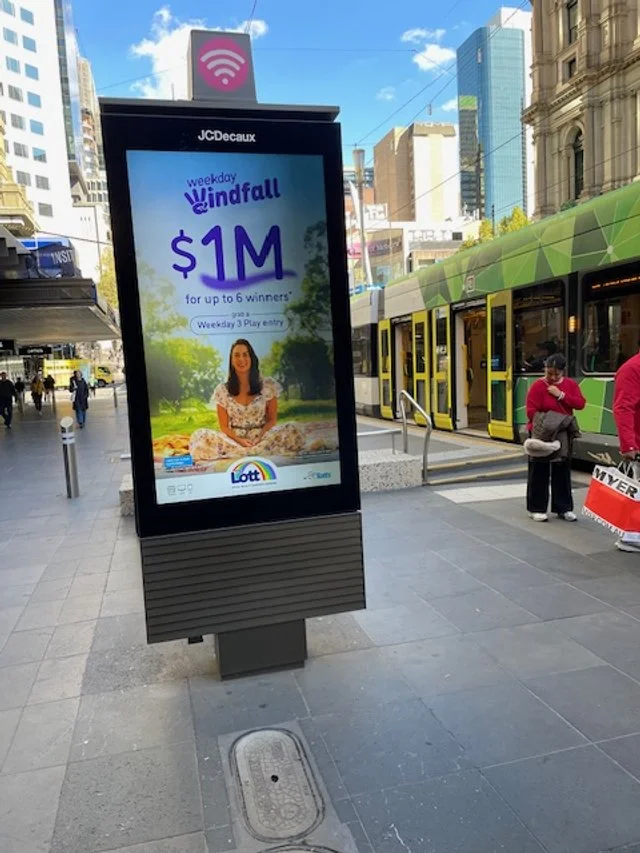
There is an interesting exception for advertising of Lottery and I have observed outdoor lottery advertising periodically, demonstrating why comprehensive policies are essential, but overall the regulation is very effective. It’s also easy to implement, with high industry compliance, because it’s public and it’s clear for all advertising companies.
Make it stand out
Alcohol advertising prohibited on Public transport
Method: contract terms and conditions
The Department of Transport and Planning has contracts with a range of companies to deliver the public transport system. This includes for example MTM to deliver the metropolitan train network (ex. Southern Cross Station), Yarra Trams for the tram network and various bus service providers (CDC and Kinetic). Each of these contracts has terms and conditions about advertising which mostly do not permit advertising that promotes alcohol or gambling. They are not all the same and it has taken me a while to dissect it.
Using a repeated process of data collection, contract review and reporting sightings of alcohol or gambling advertising to the relevant service providers I think I have put the puzzle together.
- Alcohol and gambling advertising is not permitted on the train or tram network. It is no longer permitted on buses since 2024. This is mostly working well as there is very little alcohol advertising in these places and there is a clear place to report any breaches (PTV portal) with a short turn-around of about 1 week for rectification.
- Also since 2024, alcohol and gambling advertising is not permitted on bus stops in most local government areas in Melbourne through the Bus Shelter Agreement. **Warning, this is where it becomes a puzzle!** Under the Bus Shelter Agreement councils can sign up to have their local bus stops managed by the state government under state government terms.
- There are a bunch of councils in Melbourne and all the regional councils, managing their own bus stops. Unless their individual council advertising conditions also prohibit alcohol and gambling advertising, that harmful product advertising continues in these local government areas. When driving through these council areas I often see alcohol advertising and occasionally lottery advertising at bus stops.
- The new Bus Shelter Agreement terms came into effect in 2024 – previously there was a lot of alcohol advertising at bus stops in the City of Melbourne, however I haven’t seen any for about a year (I can’t help but look out for it) and believe it is working well.
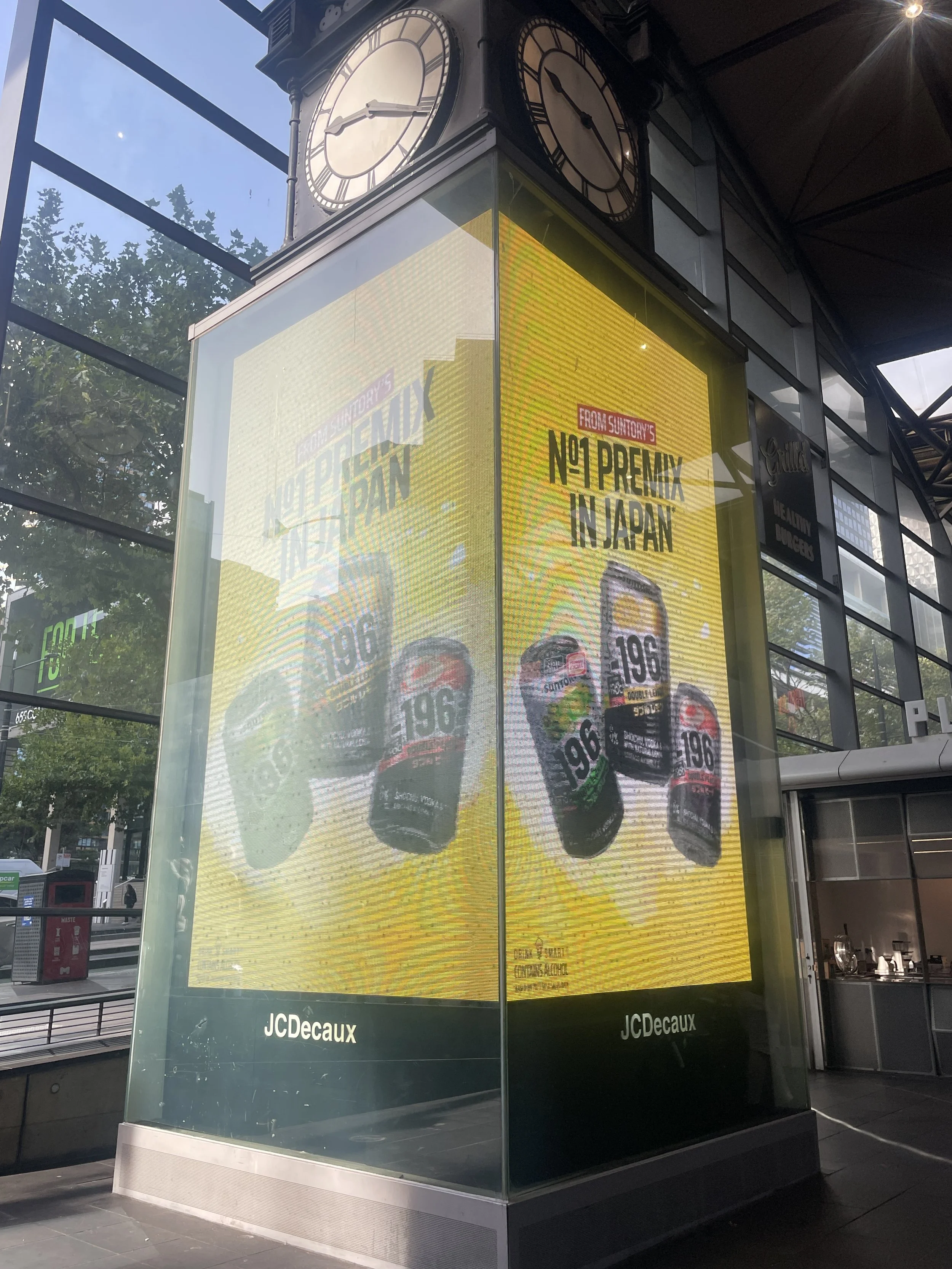
- Another piece of the puzzle is Southern Cross Station. In contrast to other train stations Southern Cross is a public-private partnership between the state government and a superannuation group. It is managed privately under a 30-year lease that started in 2006. There is no restriction on alcohol and gambling advertising under the lease terms. Advertising surveys have repeatedly shown high rates of alcohol advertising in Southern Cross Station. A survey[iv] I carried out in Winter 2024 found 24% of all ads in the station were for alcohol.
.
- The best way to solve this and the bus stop anomaly is to ban alcohol advertising through regulation. We can look to gambling to see the difference. In 2016 community concern was raised about the high amount of gambling advertising at Flinders St and Southern Cross Stations[v]. In 2017 gambling advertising was banned on public transport through an amendment to the Gambling Regulation Act 2003[vi]. I have surveyed Southern Cross Station several times over 2022-2025 and have never seen gambling advertising in contrast to the heavy alcohol advertising which is always there. An alternative second-best way to stop all alcohol advertising on all public transport is to ensure the advertising terms prohibiting alcohol advertising applying to most public transport are expanded to Southern Cross Station and all bus stops. The limitations of this approach are it will take time (such as waiting for contract end) and is not public, reducing public awareness of the policy.
Alcohol advertising prohibited near schools
Method: Liquor Control Reform Act 1998
Alcohol advertising is prohibited within 150m of schools under The Act. It is measurable and penalties apply for breaches. It is also stronger than the Outdoor Media Associations own national policy, discussed further below, which prohibits alcohol advertising within a 150m sightline of a school. The OMA code has resulted in some alcohol advertising in other Australian states being placed very close to a school where there is something blocking it being viewed from the school. The restriction under The Act is a good start however limited in impact as many bus stops outside schools do not contain any advertising and the next bus stop or train station advertising space is usually outside the 150m. By comparison most children live 1-2 km from their school travelling by foot or by car to get there[vii] likely passing several public transport stops.
Outdoor Media Association (OMA) code of advertising placement policy
Method: limiting placement of unhealthy products under the codes
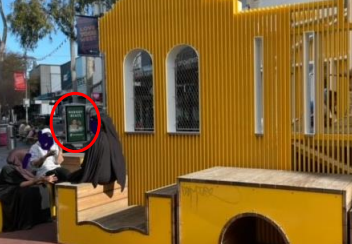
This national industry code of conduct covers placement of alcohol, gambling / wagering and unhealthy food and drinks advertising. The code is designed and overseen by advertisers of food and drinks, alcohol and gambling and has been shown time and again to be ineffective[viii] , [ix]. Under the code unhealthy products cannot be advertised within a 150m sightline of a school. There is a carve out for capital cities (so if the advertising is in a CBD it can be placed outside a school). The definition of unhealthy food and drink is narrow and does not cover products like snacks sweetened with fruit concentrate and diet soft drink. It also does not apply to brand-only advertising of unhealthy food brands (eg Fast Food, Confectionary). A further limitation is the focus on schools without acknowledgement that children attend many other places in outdoor settings. This was emphasised for me when I observed an ad for alcohol at a playground. My complaint[x] to the alcohol advertising self-regulator ABAC was dismissed (despite some level of concern expressed in the panel decision) as there are no rules around advertising alcohol at playgrounds.
We can also see the lack of effectiveness of self-regulation by comparing places where only industry policy applies with public transport which covered by the department of transport advertising guidelines.
Telstra wifi boxes do not have any restrictions on advertising outside of the state government regulation (ie no gambling advertising ex. lottery, no alcohol advertising within 150m of a school) and the OMA industry policy. While the only gambling advertising I have observed on Telstra Wifi boxes is for lottery, I regularly (daily) see unhealthy food and drink and alcohol advertising on Telstra wifi boxes – even when the box is at a tram or bus stop. The same came be said of Southern Cross Station where the alcohol advertising likes to congregate because it’s been pushed out of the other city loop stations through good policy.
Overall ratings summary:
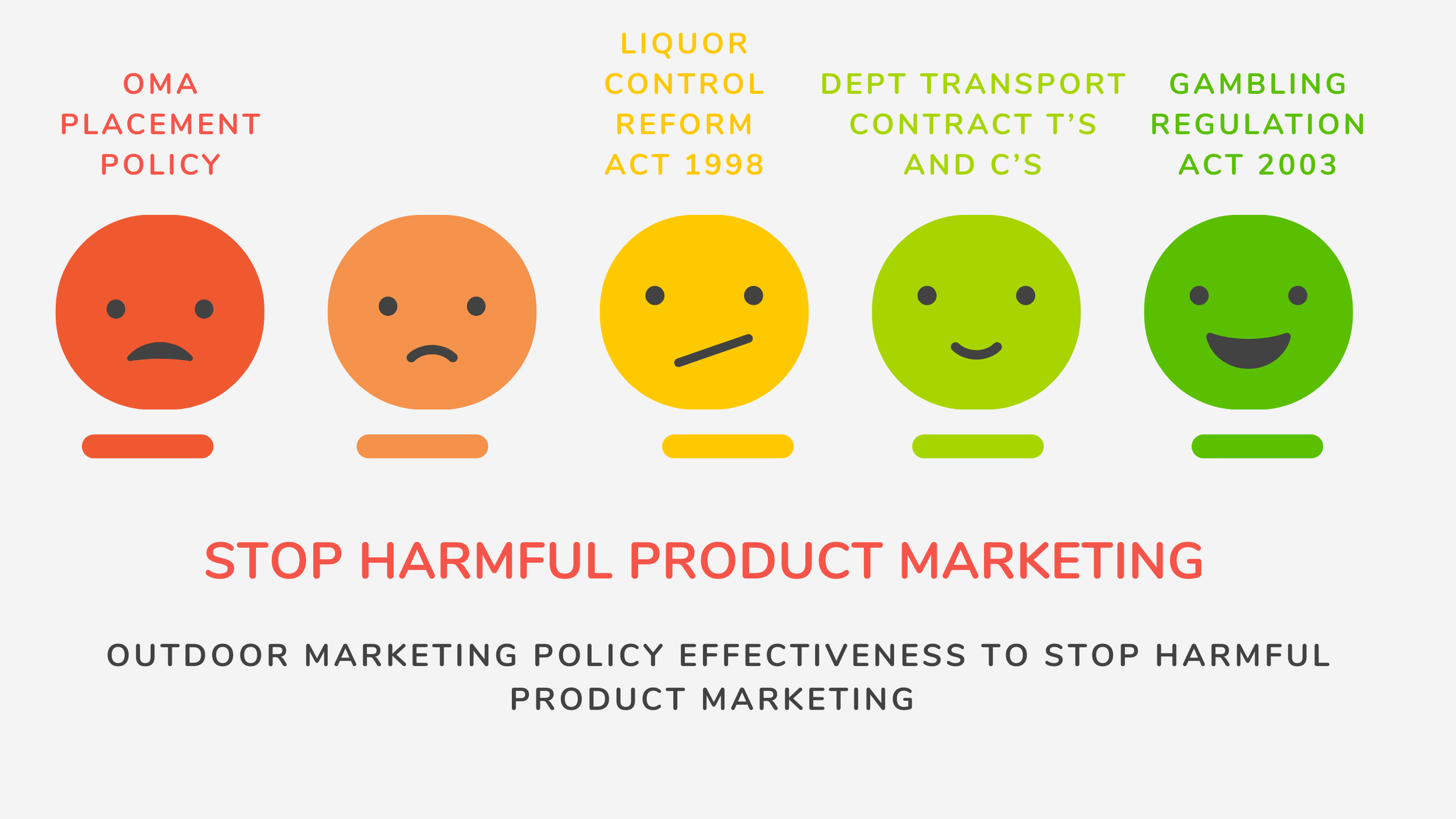
How do we better protect children and the broader community from seeing unhealthy advertising while travelling to school, activities and events? My solutions are:
Replicate the restrictions on gambling advertising in the Gambling Regulation Act 2003 for alcohol advertising under the Liquor Control Reform Act 1998. Ensure playgrounds are covered!
Unhealthy food and drink advertising can also be addressed in this way through adoption of regulation to stop unhealthy food and drink advertising.
Departmental policy on public transport must be expanded to all public transport and should include unhealthy food and drink as well as alcohol to protect all children from the youngest age.
As Victoria’s busiest railway station, Southern Cross Station must be addressed in such a policy.
As contracts come up for renewal local governments can update their advertising content guidelines in their contracts with bus shelter providers and in their agreements with Telstra for the Telstra wifi boxes to ensure alcohol, gambling and unhealthy food and drink advertising are not permitted.
[i] https://www.cancervic.org.au/about/media-releases/2024/november/almost-half-southern-cross-station-ads-push-alcohol-junk-food-or-sugary-drinks-research.html
[ii] https://bmcpublichealth.biomedcentral.com/articles/10.1186/s12889-017-4433-2
[iii] https://cancerwa.asn.au/assets/public/2022/07/Trapp-2021-Exposure-to-unhealthy-food-and-beverage-advertising-during-the-school-commute-in-Australia.pdf
[iv] https://www.cancervic.org.au/about/media-releases/2024/november/almost-half-southern-cross-station-ads-push-alcohol-junk-food-or-sugary-drinks-research.html
[v] https://www.smh.com.au/national/gambling-adverts-blanket-citys-stations-20151017-gkbn4z.html
[vi] https://www.theage.com.au/national/victoria/gambling-ads-near-schools-on-public-transport-to-be-banned-by-victoria-20160819-gqwl0z.html
[vii] https://www.rchpoll.org.au/wp-content/uploads/2019/02/20190207-travelling-to-school-habits-of-australian-families.pdf
[viii] https://pmc.ncbi.nlm.nih.gov/articles/PMC11608276/
[ix] https://www.sciencedirect.com/science/article/pii/S1326020024000232